Showing posts with label Japanese customs. Show all posts

Wednesday, January 3, 2018

I didn't run

Hashiranakatta

I think this is the first New Year's holiday since I started running that...I didn't run. Of course, I could say that it's a calendar glitch that the holiday is over so soon and that the holiday isn't actually over until Coming of Age Day (which will be next Monday) and go running by then and call it good.

Other than that...

I cleaned the kitchen fan. This is the one thing I have done consistently during the New Year Holiday the past several years.

I cooked (prepped?) datemaki (kind of a fish stock containing omelette type dish) and koh-haku namasu (halfway between a salad and pickle containing daikon radish and carrots) and char-shiu (Chinese style roast pork, which isn't traditionally a part of osechi). I also made ikura in fish cake (made meaning assembled).

I cooked dinner on the 29th and 30th and the 1st and the 3rd. We went to my parents' the night of the 31st and the Pumpkin Daddy's parents' the night of the 2nd.


I made jeans and a sweater for Tiny Vader. This needs a lot of explaining depending on your level of interest and familiarity with doll clothes and Tiny Vader. For now I'll just say I cut up a pair of jeans the Pumpkin Princess outgrew and got yarn and needles from the 100 yen shop. I made a photo studio for Tiny Vader with the cardboard boxes Amazon and Uniqlo sends my stuff in, and some 100 yen shop stuff (battery powered LED lights, plastic sheets, construction paper, paper clips, and wallpaper paste).  In terms of cost performance, both the studio and the clothing are successes, although the jeans took a few tries (and could still stand some improvement).

And now it's back to the daily grind...which I do not really look forward to. But how else am I going to be able to pay Amazon and Uniqlo?


Thursday, May 12, 2016

Please let me hold your bag

Kaban wo motasete kudasai

Year of Requirement Part 8

In my high school in Suburbia, I was on Math Team. (I was also on Speech Team, but I never competed because Japanese Saturday School got in the way of tournaments.) I didn’t even think of trying out for athletic teams (which really really makes you wonder why on earth I thought joining an athletic team in university was a good idea). Like most high schools in the US, you tried out pre-season, and you were picked to be on the Freshman, JV or Varsity team (or you didn’t make it and sulked about it or did a club team somewhere or signed up for classes at the YMCA to up your proficiency for next season).

In Japan, especially in junior high school, clubs, or bukatsu, were (and are) a big thing. Everyone can join, but not everyone gets to play. My Year of Requirement was spent in a fairly small school, so there were only a limited number of clubs. My homeroom teacher gently nudged me away from the athletic clubs and band when he found out I had no experience in any of the available clubs. (I was O.K. in gymnastics, but they didn’t have that, and swim team either practiced in their own clubs or hid behind the equipment shed and smoked. They didn’t have choir.)

I chose the drama club. I had some experience in speech, and we did musicals in junior high, so I figured I was in pretty good shape. And I was. There was no dramatic brilliance in our group. We did exercises in projecting our voices (which I’d always been good at, see also: coxing a sternloader four with a microphone is for wusses) and little skits, and the big annual event was a performance in our school festival. No competitions or anything. We were a low-key group, up there with the home economics club and science club.


One thing that drama club had that all the other clubs had was a strict system of hierarchy. First years had to answer to second years who had to answer to third years who ruled the school (of course there was hierarchy within years as well). You had to use formal language when addressing your upperclassmen and address them as “Senpai” which means “one who is ahead of me.” (This varies between schools. Most people in my part of the country used “Senpai” exclusively, but some schools address upperclassmen with the standard issue honorific of “San.” And when I was in university, you addressed upperclassmen as “Tanaka-san.”) Underclassmen fetched and carried. In athletic clubs, especially ball sports, they chased after stray balls. In band, they carried trombone cases. In drama club, they carried the lights. The peak of absurdity was underclassmen carrying the 3rd year students’ school bags from the AV room where we practiced to the main entrance of the school. It kind of falls into the whole system of seniority that runs through the core of Japanese society. It’s moronic, but that’s how the world works, so I guess you’re getting an education when you go to a junior high school in Japan.

Tuesday, March 1, 2016

That's not for the Death Star

Sore ha Desu Sutaa no tame deha arimasen

Vader ST base


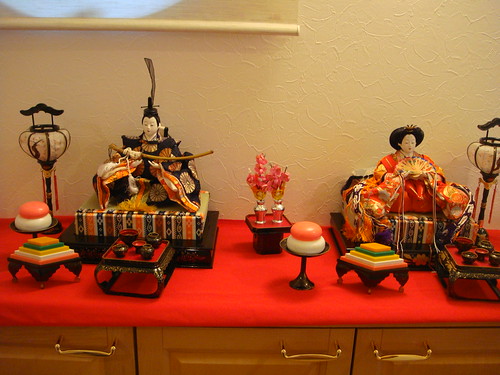
Hina Death Star
I don't think that's for the Death Star, Tiny Vader...

Hishi Mar

Vader Dairi

Hina Vader and ST

Hina dolls 2016
Thanks for your help, guys!

Monday, January 11, 2016

Proper and traditional

Seitouha

In Japan, New Year decorations are traditionally burned in a ritual bonfire. It’s called Dondoyaki. Burning is a sign of respect, because smoke goes to the heavens. 

ready

The smoke is supposed to have cleansing and protective properties, so you cook food over the flames 
when the fire has settled.


Cooking mochi (rice cakes) here is traditional. Cooking dried squid here is traditional. Cooking marshmallows here is NOT traditional. 

roasting and toasting

Cooking marshmallows isn’t traditional, period, but we’ve done it here the past couple of years because marshmallows are easier to stab on the tree branches.

So of course if we roast marshmallows, we must have s’mores. But to have s’mores, we must have graham crackers. And they are hard to come by in backwoods Japan. I expect they are available in upscale grocery stores near the US Embassy in Tokyo. I found them on Amazon, but they were 5,680 yen (plus 500 yen for shipping) for four boxes.

We made do with thin cookies I got from the local grocery store. Add chocolate and freshly toasted marshmallows, and you can’t go wrong…

s'more

but it wasn’t the same.

The Pumpkin Princess and I gave them out to anyone who looked interested, including her friends from school and their grandparents. Most people loved them. But I still felt like someone who was serving pizza with mayonnaise or sushi with soggy rice. This was their first encounter with s'mores, and I wanted it to be right for them. 

Does this make me one of these people?


Sunday, November 29, 2015

(You're) drinking too much!

Nomisugi!

Rowing Ruminations Part 4

(Again, inspired by but devoid of spoilers for the book Flat Water Tuesday)

One of the reasons the fours race was held as scheduled, as opposed to waiting it out until the next morning to see if conditions wouldn’t improve (they did, by the way), was because of the reception that evening. The guys wanted to drink with their fellow rowers. Badly. Drinking, especially their kind of drinking, required focus, the kind of focus that couldn’t be achieved with the knowledge that they had to pull 1000 meters the next day. 

The drinking culture in collegiate athletics in Japan was very strong, and flowed right into the drinking culture of corporate/ professional Japan. Crew and university are literally half a lifetime ago but my understanding is that the intensity of the drinking culture is still strong (but fewer people get involved in it), both in school and at work. My current workplace is an anomaly where the drinkers and non-drinkers do whatever they want without professional repercussions, but I know others are not so lucky.

My classmates and I and many of the guys in the year ahead of me were underage, but it was understood that 18 year-old college kids would drink, it was just a question of where, and none of the places out in town would ever card us. It was just the way things were back then. Even if they did, we could always buy beer from a vending machine. The drinking culture was just as strong outside of athletics. The upperclassmen would throw impromptu parties in their apartments, and call freshmen to join them at all hours. Getting these calls meant that your upperclassmen liked you, but the understanding was that if your phone rang, no was not an acceptable answer, even if you had morning practice or a first period exam the next day. I was exempt from all this because I was female and plus I lived with my parents in the age before beepers and cell phones (and they probably didn’t think of me as good drinking company anyway), but I know that the other freshmen on the squad were literally called at all hours of the night.

When an upperclassman filled your glass, you were expected to empty it. Not sip from it, empty it. When they called your name and clapped in time, you emptied it. It meant that they liked you, but it also meant that you’d get really drunk really fast.

Rowers were forbidden to smoke during racing season, and the legal age was 20 just like it was for alcohol, but the nicotine junkies didn’t let that stop them. (Coxswains were allowed to smoke both during and after racing season because it helped keep weight off. I never did because I couldn’t stand the smell.) The attitude toward smoking was much more lax back then. I was told in my first year by our coach and our captain that if I ever saw my rowers smoking, I should stop them, but seeing how they were upperclassmen and several inches taller and anywhere from 40 to 80 pounds heavier than me (except for that one year when those numbers were closer to 5 and 30, respectively), I opted for something milder like walking past them muttering something like “I saw K (our coach) heading this way.”

I never saw anything illegal for people of legal age like pot or heroin or cocaine, either in crew or in school or anywhere thereabouts, and this was before ecstacy was really big. Me being 1) female 2) a coxswain probably kept me from seeing everything, especially if it were questionable, but I’d still say it was unlikely.


As far as hazing goes, yes, it happened. Nothing fatal or causing major physical harm, of course, but yes, it happened in most of the “intense” clubs. First year students were the part of the totem pole driven firmly into the ground, so fetching and carrying and all sorts of scut work was ours by default. I got off a little more easily because of my gender, but the guys had it really hard. And when we were upperclassmen, we had the younger guys fetch and carry for us, too. That’s just the way we did things. We still do, in this country.

Sunday, January 5, 2014

New Year's Money Gift!

Otoshidama!

I haven't made New Year's resolutions in quite some time now. If I did, they would be

1. Do everything in my job description

2. Be more patient with the Pumpkin Prince and Princess

But 1. since my job involves a lot more than my job description, obviously some things that are IN the description are going to suffer, and 2. I think I am more patient than I used to be, but no way am I ever going to hit 100%.

So there.

But I do try to get things done during my New Year's holiday. This year, it was 9 days long, which is probably some kind of record since I started getting paid to show up every morning. I set goals, and I usually meet them about half-way.

This year's holiday goals:

1. Read 3 books about work. Not done. Got about 1/3 through the first book.

2. Watch Season 4 of Big Bang Theory. Not done. Almost done with the first disc (of 3).

3. Exercise at least 4 times. Not done. Did Ripped in 30 twice, and went skating with the Pumpkin Prince and Princess. The latter involved a lot of pull-ups, as in "pulling up a 16 kg child when he falls on the ice."

4. Take the Pumpkin Princess skating. Done. See 3.

5. Sew something. Not done. At all.

6. Self-color hair. Not done, but I guess I still have tonight to do it.

7. Cut Pumpkin Princess's hair. Done.

8. Do a bit of work e-mailing. Done.

So that's it for my 9 days. The Pumpkin Daddy took the Prince and Princess to Toys 'R Us to spend their otoshidama (New Year's gift money from friends and relatives), so I had a few moments to write. They're still not back, so maybe I should see how far I can get through the book in 1…

(Update: I colored my hair and read an additional 20 pages of my book during the wait time. And my arms are very sore. The Pumpkin Prince is to blame, not Jillian Michaels.)

Sunday, January 15, 2012

Well prepared

Junbi ga ii

What do people who celebrate Christmas with a live tree do with the tree? Do they chop it up and leave it out for the trash? Use it for firewood?

In Japan, there is a designated method of disposal for New Year decorations. They are burnt in a traditional bonfire. The ceremony is called "dondoyaki" or "dondonyaki"  in Pumpkin Prefecture (other names in other areas include but are not limited to "tondoyaki" "dontoyaki" and "sagicho" but they all involve burning New Year decorations) and it usually takes place on January 15th or thereabouts (adjusted these days so that it falls on a weekend and everyone can take part). 

The week before, local kids will come knocking at your door to collect your New Year decorations and two-eyed daruma dolls. Their loot will be placed in a great tower, with straw mats and firewood added for form and flammability.


Our local dondoyaki took place in the park the Pumpkin Prince and Princess frequent. The fire department stands by, just in case. 


This is my neighbor. She came prepared with dried squid skewered on twigs. When the bonfire settles, she'll roast the squid to eat. Others came with mochi (rice cakes) on sticks, and sweet potatoes in tin foil.


Here they are, getting ready to light the fire. Not all the darumas have actually earned their second eye. Many (o.k., nearly all) were bought and given two eyes just for today.


Ready, set!


Just gonna stand there and watch me burn....


It only took a minute or so for the blaze to reach full force. To be honest, until this moment, I thought the Fire Department was kind of overkill. Now, I am glad they were there.


After the blaze settled down, everyone who came prepared roasted their squid and mochi. Eating food cooked by the dondoyaki flames is supposed to bless the person with good health throughout the year.

Sunday, May 22, 2011

Formal dress

Seisou

The dress code for the party was "formal." So we all compared notes and decided it would be a good time to wear kimonos. As a married woman, for most formal occasions, I wear what is called a "houmongi," or "visiting dress." It's a kimono with standard length sleeves, and a large pattern that is either dyed or embroidered (tradition dictates that formal kimonos have large printed or embroidered patterns. Small printed patterns and woven patterns are considered less formal, even though they sometimes are more expensive. I guess it's like a JCrew cocktail dress being more affordable than a pair of Chanel jeans).

Of course, I do not own a houmongi (or a small print kimono or a woven pattern kimono, or for that matter, a JCrew cocktail dress or Chanel jeans), so I rented one. And I did not know how to dress myself in it, so I went to my trusty hairdresser (some Japanese hairdressers are also licensed kimono dressers). She did my hair and makeup, and then padded me in towels and gauze until I was the right shape (the design of the kimono is such that you want to be as cylindrical as possible) and then proceeded to strangle me dress me in my (OK, the dress shop's) beautiful kimono.


The sash, or obi is just as important, if not more so, than the kimono. The best are pure silk, and are frequently more expensive than the kimono. The way it is tied reflects your age social status. This plain flat tie shows I am an married lady.


Hair is always done up, although these days, most people (including me) get it done the way you would do for evening dresses.

Please don't ask me how I'm supposed to go to the toilet in this thing. Fortunately nor not, I didn't need to.

Wednesday, February 25, 2009

Doll Festival is coming.

Mousugu Hinamatsuri

It's almost Doll Festival again. I need to get the dolls out soon.

In the meantime, the Pumpkin Granny made this for her favorite princess.


They're called tsurushibina. The Pumpkin Granny stitched each of the pieces by hand from silk fabrics.


Mice are symbols of fertility.


Dogs (yes, that's a dog, not a cat) are symbols of fertility and uneventful, easy childbirth. So very important in the days before retirement benefits and emergency C-sections.


Cranes and turtles are symbols of longevity.


And, of course, something for girls would not be complete without a fan.


It's absolutely beautiful.

There's just one thing, though.


I REALLY need to find a better place to put it.

Tuesday, November 11, 2008

Which flavor would you like?

Nani aji ga ii?

Sheri, here they have plain salt, pepper, curry, caramel, chocolate, cappuccino, honey, and strawberry flavored popcorn. Certain flavors are sold in only certain parts of the park, and the guide map they give you has a special section that tells you where each kind is sold. They also have a flavor called sea salt that they sell only at the Mermaid Lagoon (where else?) You can buy special Disney character buckets as well, but I understand Anaheim has those, too. I was wary of the stray unpopped kernel, so I didn't get the Pumpkin Princess any.


Here are some pictures of the candies and cookies we bought, or rather, their containers. Mine (the small Mickey and Minnie tin and the Mickey and Minnie as snowmen package) are unopened because I haven't taken them in to work yet, and the Pumpkin Daddy's are empty (his co-workers told him to take the packaging home to the Pumpkin Princess) so I don't have any pictures of the actual sweets to show, but other than the Pooh chocolate cookies being shaped like Pooh's head, they're plain round or square candies and cookies. The decoration on the top of the snowmen package is a plastic clip that can be saved for clipping papers together.

Wednesday, October 15, 2008

Let's go home.

Ie ni kaerou.

(TMI alert!)

My grandmother was a tiny woman, so her ashes fit in the urn without much trouble. My maternal grandfather, on the other hand, was a bit tall for someone his generation. When he passed away, and the family passed the bones from one pair of chopsticks to another, and the crematorium attendant had swept everything off the gurney, the lid would not fit. So the attendant did the only thing he could do, which was take out the skull bones, pack everything down a bit, resulting in a distinctive crunching sound, and put the bones of the skull back.

(end TMI)

After the ashes are, ahem, placed in the urn according to tradition, they are taken back to the ceremony hall. When you go back to the ceremony hall or temple, you must never go back using the same road, because the spirit of the dead might follow you back. (This presents an interesting problem in rural areas where there are a limited number of roads.) Back at the temple or ceremony hall, more prayers are offered. According to tradition, more prayers are supposed to be offered on the 7th day after death, but these days, it's so hard to get everyone together so frequently, you'll just pretend seven days have passed and offer another set of prayers at this time. After all that chanting about how life sucks is done, the family will share a meal. and then go home with the ashes, and the ashes are placed at the family alter or some other safe place. They're kept at home for 49 days, according to tradition, during which the family goes into mourning. Mourning is a relative term. You give offerings of food and sweets and whatever else the deceased liked, but you don't cover all the mirrors or dress in black or stop singing or playing the piano the entire time or anything, at least not these days, anyway. I know of a family who went skiing during their period of mourning when their dad died. They put the urn in a backpack and skiied down his favorite slope.

On the 49th day, (these days, however, it might not be exactly 49 days because the 49th day might not be on a weekend) prayers are offered again (with the same reminder that life sucks but it goes on) and the urn is placed in the family grave. The family is left with a tablet-like plaque on which the deceased's new name is carved. This plaque (ihai) is very important, and is the third thing you grab in case of a fire (after the baby and the bank book).

Graves are supposed to be visited regularly, but tradition requires visits on the 1st, 3rd, 7th and 13th anniversaries of death.